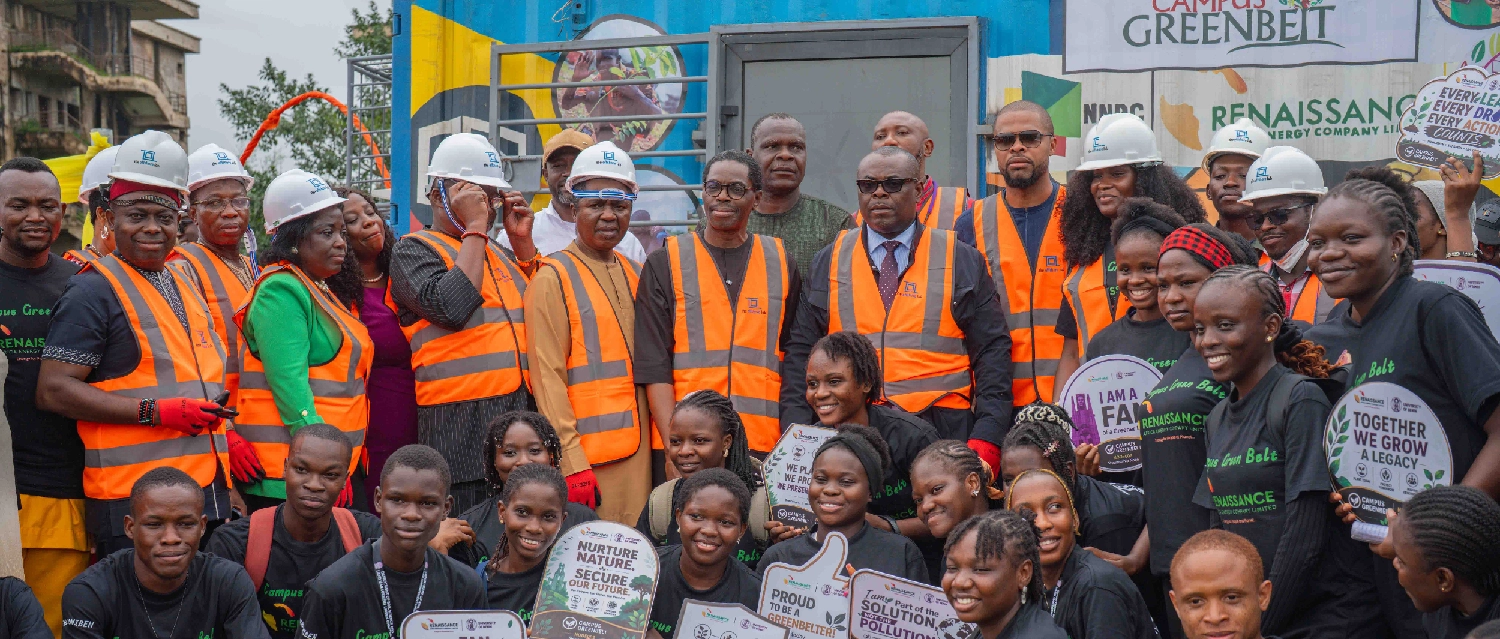
A building can be completed. A water system can be commissioned. An ICT centre can be equipped. A training programme can graduate hundreds of people. A thousand trees can be planted. All of these projects can be delivered on time, within budget, to specification and with an excellent safety record - and yet the most important question can remain unanswered: what changed because the project existed?
Did the water system reliably reduce the time households spend searching for safe water? Did the ICT centre become an active platform for skills, research, enterprise and employability, or merely a room full of equipment? Did the training create competence that organisations actually use? Did the trees survive, create shade, improve biodiversity, produce food and build a culture of environmental stewardship? Did local businesses and workers retain meaningful economic value from the project? Did the institution become more capable of sustaining the asset after the contractors left?
These are not public-relations questions. They are project-success questions.
For decades, project delivery has rightly been disciplined around scope, schedule, cost, quality, safety and risk. Those controls remain indispensable. But they describe whether we delivered the project well; they do not, by themselves, establish whether we delivered the right change.
That distinction is the foundation of what we at The Offshore Lab call Project Impact Accounting.

What is Project Impact Accounting?
Project Impact Accounting is the discipline of designing, measuring and accounting for the lasting value a project creates beyond its physical delivery.
It asks project owners, sponsors, designers and delivery organisations to treat impact with the same seriousness with which they treat cost, schedule, quality and safety. That means defining the intended change before execution, designing the project around that change, establishing baselines and measures, collecting evidence during delivery, testing whether outcomes occur after handover and using the results to improve the next investment.
The word accounting matters. Financial accounting does not simply tell a company how much money entered or left a bank account; it imposes a disciplined system for classification, evidence, reconciliation and accountability. Project Impact Accounting applies a similar mindset to value. It creates an impact ledger alongside the delivery ledger.
The delivery ledger records what was built, bought, installed, trained, spent and completed. The impact ledger records what changed, for whom, how much, for how long, with what positive and negative consequences, and how much of that change can credibly be connected to the project.
This does not mean forcing every outcome into a monetary value. Some impacts can and should be monetised when the method is credible and useful; others are better expressed in physical, social, environmental, institutional or qualitative terms. The objective is not to turn people and ecosystems into numbers. The objective is to make the value created - and the value lost - visible enough to influence decisions.
The missing second ledger of project delivery

The two ledgers are complementary, not competing. A project that creates impact but is technically unsafe or financially uncontrolled is not a good project. Equally, a technically perfect asset that is unused, unsustainable or disconnected from the need that justified it is not a complete success.
Why this matters now
The project-management profession itself is moving in this direction. PMI’s latest definition of project success centres on whether projects deliver value worth the effort and expense, explicitly moving beyond the traditional triple constraint. Its current PMBOK guidance emphasises value delivery, accountability and sustainability. Benefits Realization Management links strategy, deliverables, outcomes and sustained benefits.
Sustainable project management is also becoming more operational. The 2026 PMI-GPM P5 Standard embeds social, environmental and economic impacts into governance, with impact thresholds, scoring and lifecycle thinking. Development evaluators have long asked whether interventions are relevant, effective, efficient, impactful and sustainable. Impact-accounting and impact-management communities are developing increasingly rigorous approaches to impact pathways, materiality, valuation, attribution and stakeholder outcomes.
These developments point in the same direction: finishing the work is no longer enough. Project teams need to become accountable for value.
Completion is an event. Impact is a condition that must survive the event.
From outputs to outcomes to impact
One reason impact is often poorly managed is that outputs, outcomes and impact are used interchangeably. They are different layers of the project story:
- Output: the direct product of project activity - for example, a borehole, 100 computers, a training cohort, a solar array, a kilometre of pipeline, or 1,000 planted trees.
- Outcome: the change in behaviour, performance, access, capability or condition enabled by that output - for example, reliable access to safe water, higher digital proficiency, reduced downtime, improved learning, or higher tree survival.
- Impact: the broader or longer-term significance of those outcomes for people, institutions, communities, the economy or the environment - for example, stronger livelihoods, institutional resilience, lower environmental burden, improved human capital or a more productive local ecosystem.
A project team has strongest control over outputs. Its control over outcomes and impact is progressively weaker because many external factors intervene. Project Impact Accounting does not solve that causal complexity by making extravagant claims. It makes the complexity explicit: baselines are recorded, assumptions are stated, contribution is tested, other actors are recognised and evidence quality is disclosed.
The questions every serious project should be able to answer
- What need are we actually trying to change, and what is the baseline before we intervene?
- Who experiences the project’s positive and negative effects?
- What outputs are required, and how must they be designed to enable the intended outcomes?
- What changed after delivery - not only what was installed?
- How large was the change in scale, depth and duration?
- What would likely have happened without the project, and what is our reasonable contribution to the observed change?
- What unintended consequences, trade-offs or negative externalities were created?
- Can the institution, community or operating owner sustain the asset and the benefit?
- What local skills, jobs, suppliers, technologies or capabilities remain after project close-out?
- What should the evidence change about the next design, budget or investment decision?
Impact has a debit side as well as a credit side
A credible impact account cannot be a catalogue of good news. Projects can create disruption, carbon emissions, waste, safety exposure, exclusion, maintenance burdens, inequitable access, dependency, displacement or assets that institutions cannot afford to operate. A project may create positive outcomes for one group and negative outcomes for another.
This is where the accounting mindset becomes useful. If we only record positive stories, we are doing communications. If we record material positive and negative effects, assumptions, trade-offs and uncertainties, we begin to build accountability. The aim is not perfection. It is decision-useful honesty: understand the total value equation early enough to design out avoidable harm and design in more value.
Design impact before construction starts
The greatest mistake is to treat impact measurement as something that begins after commissioning. By then, many of the most important impact decisions have already been made.
A water project designed only around hydraulic capacity may overlook walking distance to collection points, access for older people or persons with disabilities, household affordability, local operating capability, water-quality monitoring, spare-parts availability and the time burden traditionally carried by women and children. An ICT centre designed around equipment specifications may overlook curriculum integration, instructor capability, internet continuity, maintenance, industry partnerships and actual student utilisation.
Project Impact Accounting therefore starts at need assessment and concept selection. Impact becomes a design input. Procurement, technical specifications, local-content strategy, operating model, training, community participation, maintenance planning and data collection are all treated as levers in the impact equation.

The Project Impact Accounting lifecycle
1. Define the need and baseline - Describe the problem in measurable terms. Identify affected people and institutions, existing conditions, material risks, contextual constraints and the outcomes that matter.
2. Set the impact thesis - State how project activities and outputs are expected to produce outcomes. Make assumptions explicit and identify what would need to be true for the benefits to last.
3. Design for impact - Translate intended outcomes into design choices, specifications, procurement requirements, local-content plans, training, governance, maintenance and operating arrangements.
4. Build the impact ledger during delivery - Track outputs and leading indicators, record design decisions, collect evidence, document local participation, monitor negative effects and keep the impact case alive through project controls.
5. Verify outcomes after handover - Measure utilisation, performance and stakeholder outcomes at appropriate intervals. Compare with baseline and targets. Test contribution and disclose limitations.
6. Account, learn and improve - Produce a Project Impact Statement that reconciles intended and actual value, captures lessons and feeds evidence into the next investment, design or scale decision.
What should be accounted for?
The material dimensions will differ by project. A practical PIA account can, however, test value across six recurring lenses:
Economic and local value: Local jobs and suppliers, capital retained in the economy, productivity, operating cost, affordability, enterprise activity and lifecycle value.
Human capital and capability: Skills, competence, certifications, employability, knowledge transfer, leadership, confidence and the ability to operate or maintain what was delivered.
Social and community value: Access, inclusion, health and safety, time saved, dignity, participation, trust, social cohesion and distribution of benefits among affected groups.
Environmental and climate value: Energy, emissions, water, waste, biodiversity, land use, resilience, resource efficiency and material environmental trade-offs.
Institutional and system value: Governance, operating systems, data, maintenance capability, partnerships, policy alignment, institutional resilience and the ability to scale or replicate.
Asset performance and legacy: Utilisation, uptime, service quality, maintainability, lifecycle condition, benefit duration and whether the project continues to solve the original need.
Four examples: the difference between counting delivery and accounting for impact
Community water infrastructure
Delivery counting: boreholes drilled, tanks installed, kilometres of pipeline laid, fetching points commissioned.
Impact accounting: water quality and reliability, households served, average access time and distance, service downtime, affordability, local O&M capability, user satisfaction, time released for productive or educational activity and durability of the system.
University ICT and innovation infrastructure
Delivery counting: computers installed, smart boards supplied, seats created and facility handed over.
Impact accounting: facility utilisation, teaching hours enabled, digital competencies gained, certifications, research and enterprise activity, industry engagement, equipment uptime, instructor capability and graduate opportunities influenced by the facility.
Campus greening and orchard programmes
Delivery counting: trees planted and irrigation installed.
Impact accounting: survival rate, canopy development, water efficiency, biodiversity, fruit yield, student stewardship, climate literacy, maintenance capability, community knowledge transfer and the persistence of the green asset over multiple seasons.
Rapid education infrastructure
Delivery counting: modular classrooms delivered, desks installed and learners enrolled.
Impact accounting: learning hours restored, attendance, retention, teacher capability, digital access, learner progression, utilisation, continuity through displacement and whether the model reaches children who would otherwise remain outside formal learning.
What Project Impact Accounting is not
- It is not a replacement for project controls, engineering assurance, finance or HSE.
- It is not the same as project accounting, which primarily tracks project costs, revenue and financial transactions.
- It is not simply ESG reporting. ESG disclosures usually operate at enterprise or portfolio level; PIA asks what happened at the level of a specific project and why.
- It is not a post-project CSR story assembled after the fact. Impact must shape design and execution before it becomes communications.
- It is not a promise to monetise every human or environmental outcome. Monetary valuation is one tool, not the definition of credible impact.
- It is not an excuse to claim causality without evidence. Attribution, counterfactuals, uncertainty and contribution must be handled transparently.
A stronger definition of value for Africa’s project economy
The argument for Project Impact Accounting is particularly important in Africa, where scarce public, corporate and development capital has to solve unusually large infrastructure and human-development needs. The question cannot only be how many projects we can finance. It must also be how much durable value we can extract from every naira, dollar, engineering hour and community intervention committed to them.
That requires a shift in posture. Sponsors must procure for outcomes, not only outputs. Designers must understand people and operating systems, not only technical specifications. Contractors must see local capability, sustainability and handover as part of project quality. Institutions must budget for utilisation and maintenance. Communities must be engaged as participants in durability, not merely described as beneficiaries. Project managers must remain curious about what happens after practical completion.
This is not about loading every project with an impossible social agenda. It is about being explicit about the value the project already claims to exist for - and then managing that value as deliberately as we manage the asset.
The future of project delivery is not only to build more. It is to account for more.
From project close-out to Project Impact Statement
A mature PIA practice would add a Project Impact Statement to the normal close-out architecture. It would not replace the completion certificate or final account. It would sit beside them and continue after them. The statement would record the baseline need; intended outcomes; material positive and negative impacts; the project’s impact indicators; actual performance; evidence quality; contribution assumptions; sustainability risks; and the actions required to preserve or increase benefits. For some projects it could be updated at six, twelve and twenty-four months after handover.
Over time, organisations would build a portfolio of comparable project impact accounts. That evidence would answer a question that most capital programmes struggle to answer today: which kinds of projects, designs, partners and delivery choices create the most enduring value - and which merely create outputs?
The discipline we want to advance
Project Impact Accounting is not presented here as a finished global standard. It is a discipline we believe project owners and delivery organisations should advance: a way of connecting modern project management, sustainability, benefits realisation and impact measurement around a simple principle of accountability.
Every project creates a footprint larger than its physical asset. It spends money, develops or imports capability, consumes resources, changes places, redistributes time, affects people, strengthens or weakens institutions and creates consequences that can last long after the project team demobilises.
We should account for those consequences with the same seriousness we bring to the project schedule and the final account.
Because the ultimate question is not only: What did we deliver? It is: What changed - and did that change last?